
The outgoing governor leaves behind a record of progressive achievements, fiscal improvements, and late-term decisions that reshaped New Jersey politics — not all of them as intended.
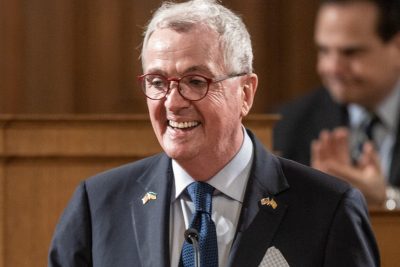
Phil Murphy’s eight years in Trenton end at noon, Jan. 20, or more precisely, 11:59 a.m.
The governor was an unabashed liberal, so his administration should be viewed through those lenses.
With that in mind, what did he do to make Democrats and liberals happy?
He raised the minimum wage – more than doubled it, in fact, to where it is now – almost $16 per hour.
He backed giving driver’s licenses to those here illegally. That remains controversial. Defenders say it’s a matter of public safety in addition to fairness.
The governor supported the legalization of recreational marijuana.
He also expanded voting opportunities through early voting.
The above, as stated, were liberal initiatives.
There were also, however, accomplishments that some Republicans may have liked. Of course, one must say that guardedly in these polarized times.
Under Murphy’s watch, the state’s budget surplus rose to nearly $7 billion. It was less than a billion when he took office.
True, the state benefited by getting federal COVID-related money, but having a huge surplus is better than not having one.
This is one reason why the state’s credit rating rose numerous times under Murphy’;s watch. Cynics may say this just makes it easier to borrow more money. True again, but a high credit rating is a good thing, not a bad thing.
The governor was also able to make full payments every year into the pension system and to fully fund public schools under the current formula. That last achievement needs some clarification as many lawmakers say the school funding formula is deficient.
And in one of his last acts, the governor signed a bipartisan bill that effectively bans student cell phone use in school.
Now, we come to missteps, or things that did not happen.
New Jersey remains a high tax state. This is not necessarily the fault of Phil Murphy. It’s not as if previous governors fixed this problem. The culprit is property taxes, which is a function of home rule more than anything else. After all, we remain a state with 564 distinct municipalities and more school districts than that.
The view here is that the biggest black marks against the governor revolve around his failure to protect transparency and in his second term, a bad case of political arrogance.
Murphy signed two bills that directly hurt the public’s right to know what’s happening with their government.
One weakened the Open Public Records Act or OPRA, which allows citizens to gain access to all sorts of government records and info. The changes make it easier for various levels of government to deny access to records.
Murphy also backed a law that weakened the Election Law Enforcement Commission or ELEC, which oversees elections. The changes reduce the amount of time ELEC has to investigate wrongdoing to two years. That seems like ample time, but many campaign violations take awhile to surface.
Finally, the governor in the fall of 2023 backed his wife, Tammy, for a seat in the U.S. Senate. This had enormous political consequences.
Rank and file Democrats refused to go along and backed Andy Kim for the Senate. Kim, of course, won the seat.
More importantly, a lawsuit by Kim eliminated the “county line,” which allowed county political organizations to “control” primaries by devising a ballot that favored an endorsed candidate.
That was not what Murphy had in mind when he endorsed his wife for the U.S. Senate.
By William Swanson, Special to The Central Observer